Tuesday, March 12, 2024

Friday, January 21, 2022
Thursday, November 14, 2019
Day #1 at AASL19
 We arrived in Louisville last night at 10:20pm after a full day of work. The drive wasn't too bad and we did not run into any bad weather. I have to say that arriving at the convention center for registration and things starting afternoon, was a really nice, slow start to the day. Day 2 and 3 will be way more intense - no doubt.
 We walked through the IdeaLab which was totally packed (great for the presenters), wandered by the universities offering Library Science Degrees (woohoo Wayne State) and then got ready for the Opening General Session.
I got to participate in the parade of affiliates, which was/is a really fun idea. That was something new for me. I love that all the states get recognized and I feel that this is something special that AASL can offer because of how state school library organizations are able to participate at affiliate assemblies.
Finally, I have to say that Ellen Oh was a great choice to kick off the conference. Her story was really moving and a good reminder for us to keep providing those books to students. You never really know when you might match the perfect book for a reader at the right time in their life. It might make all the difference in the world.

Thursday, November 7, 2019
ALA Annual Conference 2019
 Wow! Going to the American Library Association Conference is informative, exciting, overwhelming and exhausting; all in good ways. One of the main reasons I wanted to go this year is because it’s amazing to be surrounded by so many librarians and because it’s one of the best places to learn about what is going on in our field and in other types of libraries. There are many times that I only do school library professional development and it feels really good to branch out and learn about librarianship in general and how our jobs are both similar and different. Another reason I wanted to go this year is because I was the chairperson for an AASL award committee and part of the commitment was to be there to present the award. It was my first time on a national level committee and it was something I look forward to doing again.
Upon arriving in Washington DC, I found some of my Michigan Association for Media in Education (MAME) friends and we went to get our registration taken care of before the mad rush the next morning. There were already a lot of people there, but it went fast and it was really nice to be walking distance to the convention center. ALA President Loida Garcia-Febo kicked off the conference with an update of what she accomplished during her term. Garcia-Febo worked toward advocacy for all libraries, had a wellness campaign for library workers, emphasized international libraries, worked to support diversity and took time to do a lot of library tours. Her slogan was “Libraries = Strong Communities” and she mentioned that PLA was turning 75 years old. As part of the advocacy for libraries, everyone in the audience was encouraged to text LIBRARY to 52886 so that a message supporting libraries would go to our representatives in Washington.
Jason Reynolds was the keynote speaker at the Opening General Session. He mentioned that last year Michelle Obama was the keynote speaker and he had some pretty large shoes to fill. As expected, Reynolds delivered an empowering speech in a story told in 4 parts. It was really amazing to sit there and listen to a great storyteller weave his magic live and in front of thousands of people. He told the audience to keep putting books in the hands of readers and that we could change their lives with the right story. His website has a perfect summary of his message:
“I know there are a lot — A LOT — of young people who hate reading. I know that many of these book haters are boys. I know that many of these book-hating boys, don't actually hate books, they hate boredom. If you are reading this, and you happen to be one of these boys, first of all, you're reading this so my master plan is already working (muahahahahahaha) and second of all, know that I feel you. I REALLY do. Because even though I'm a writer, I hate reading boring books too.”
https://www.jasonwritesbooks.com/about
 I tried to go to as many sessions as possible because I really value those 5 days of learning. However, one does not miss the opening of exhibits Friday night! Exhibits open for those attendees who are there for the full conference. There are some authors who come only for this time. Many of the book giveaways are exclusive for the opening event. There is food, cake, beer, and wine. You just have to pace yourself on the giveaways because it’s no fun lugging around an 80-pound bag for 2 hours. I did manage to get a lot of great books and some fun advance reader copies. I really try to post on my library Instagram, twitter and write a review for my blog about the books I pick up. If publishers give us free books to review, I feel that they should be given a fair evaluation and praised when appropriate. It also helps me to learn what is coming out for potential collection development. The exhibit floor has the Book Buzz Theater and PopTop Stage which has sessions running throughout the day. These tend to be individual authors, publishers and author panels which I think are a lot of fun. I enjoy hearing authors talk about the books they wrote and the passion they have for their readers. I wish more students got to experience events like this.
One of my favorite publisher sessions - the HarperCollins Adult Book Buzz. It usually comes with breakfast and a bag of books. It’s run by the library marketing team, aptly named LibraryLoveFest. Their blog is here: https://www.librarylovefest.com/ While I work with mostly YA, I like to know what’s popular in the adult world and just keep up to date with all the great new books coming out all the time. Plus, they do some really great book talks. I also attended the Penguin Random House “Fresh Picks” Book Buzz, which is hosted by their library marketing team. I’ve utilized their summer reading kits for my high school students because a lot of their suggestions are adult books that are good for teens looking to explore outside of YA. Their library portal and handouts are here: http://penguinrandomhouselibrary.com/ .
 I spent a lot of time in exhibits this year because I did not have to be at any mandatory meetings. I took the time to talk to the vendors that I work with. I stopped by the Follett booth and just about every publisher you can think of that was there.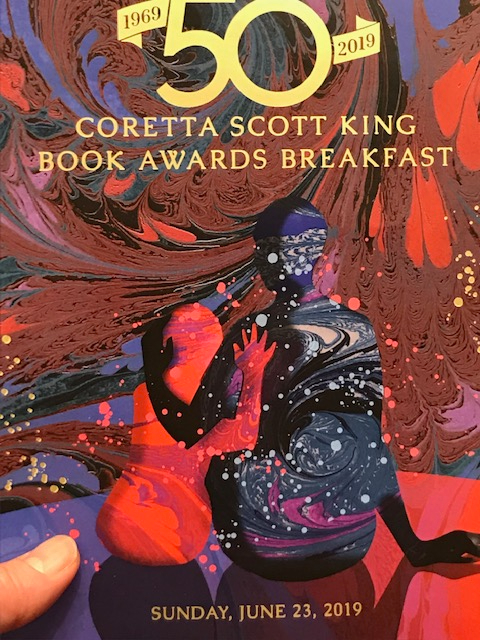
 I branched out this year and did some new things. I attended ALA Play which is hosted by the Games & Gaming Round Table (GameRT). They had a lot of games set up, giveaways and it was a great way to meet new people. We were there for a couple of hours before we decide to get a really late dinner (like 10pm late…).
This was the 50th year of the Coretta Scott King Book Awards and they had a big event planned to commemorate this milestone. It was a very early 7:00 am breakfast before they got to the awards. The entire program was a lovely celebration of some very talented illustrators and writers. The hashtag of #CSK50 was used to document the event by the participants there.
I branched out this year and did some new things. I attended ALA Play which is hosted by the Games & Gaming Round Table (GameRT). They had a lot of games set up, giveaways and it was a great way to meet new people. We were there for a couple of hours before we decide to get a really late dinner (like 10pm late…).
This was the 50th year of the Coretta Scott King Book Awards and they had a big event planned to commemorate this milestone. It was a very early 7:00 am breakfast before they got to the awards. The entire program was a lovely celebration of some very talented illustrators and writers. The hashtag of #CSK50 was used to document the event by the participants there.The Auditorium Speaker Series that stood out to me the most was George Takei. He has an upcoming graphic memoir, They Called Us Enemy, which is coming out very soon. When George Takei was 5 years old, he and his family were rounded up by the US Government and put in a American concentration camp. He could not understand why he was there because he knew he was American. He was one of the 120,000 Japanese Americans who were rounded up and locked up by our government. As he grappled with the idea of forgiveness, he has become one of our most outspoken people in the fight for social justice, LGBTQ rights and marriage equality. He uses his fame from Star Trek and now as an author to speak for those who cannot speak for themselves. During a Q & A session, George was asked how he feels about the prison camps we have set up right now for refugees and what they have done to children. He said that he cannot compare the experience to his own because he was at least with his family. They were never separated. Takei shared the message that the horror of separating children from their families will cause irreparable damage to those suffering through it.
Matt de la Pena headlined the AASL President’s Program. His message was that of providing inclusiveness and equity is a must for all learners. He shared stories from his own life and how important it is for kids to have goals. His father helped him to understand the importance of literacy and when he was in college books were his “secret place to feel.” He talked about his latest book, Love, and how he wrote that book to be as inclusive as possible. He stated that “when you give someone a book, you’re not just giving them a book, but a new way to navigate the world.”
On Saturday, AASL honored their award and grant recipients. A lot of AASL people from the ALA office were there, along with the elected officers. I presented the Frances Henne Award to Holly Schwartzmann from Largo Middle School in Florida. She received $1250 from ABC-CLIO to attend AASL National Conference for the first time. This award is for a school librarian with five years or less experience who demonstrates leadership qualities with students, teachers and administrators. It was exciting and promising to present this award to a new librarian who has made such an impact in a short amount of time. There were quite a few MAME members in attendance as well as school librarians from all over the US.
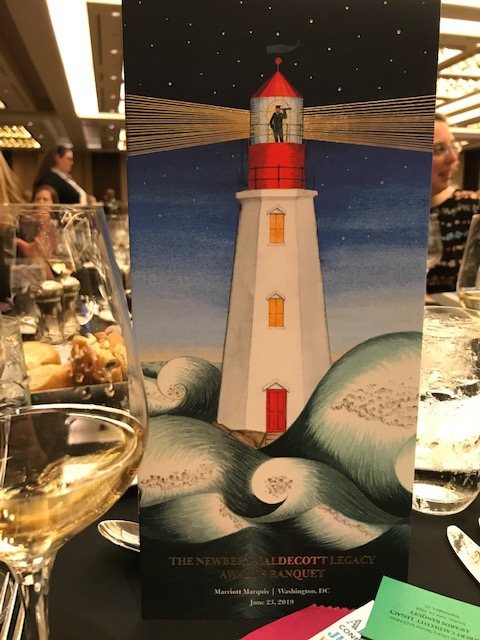 On the evening of June 23, I got to attend the Newbery Caldecott Legacy Awards Banquet. Meg Medina received the Newbery Medal for Marci Suárez Changes Gears, Sophie Blackall won the Caldecott Medal for Hello Lighthouse and Christopher Myers accepted the Children’s Literature Legacy Award on behalf of Walter Dean Myers. Their speeches will be posted here: http://www.ala.org/alsc/awardsgrants/bookmedia/NCWBanquetRecordings .
Overall it was a wonderful experience to join these authors and illustrators talk about their path to winning some of the most prestigious awards in children’s literature. I think everyone should experience it at least once to be a part of the excitement surrounding children’s literature and the impact it can have. It would be exciting to be a part of the award selection committees and I am in awe of how they set so much time aside to read all those books! That is a major commitment to their profession and to our organization and I thank them for all their hard work. Five days seems like a long time for a conference, but it goes by so quickly.
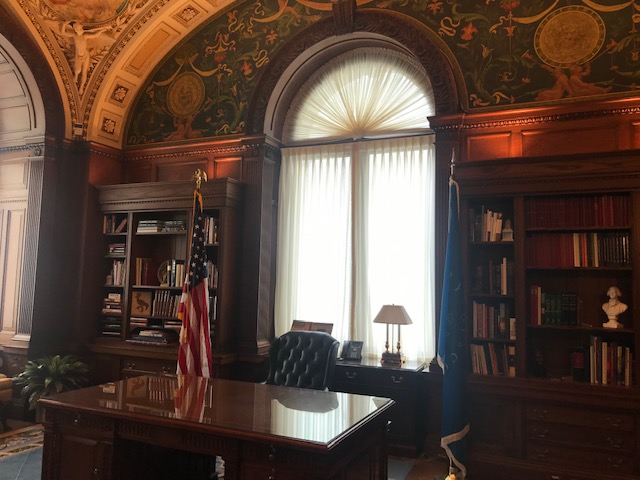
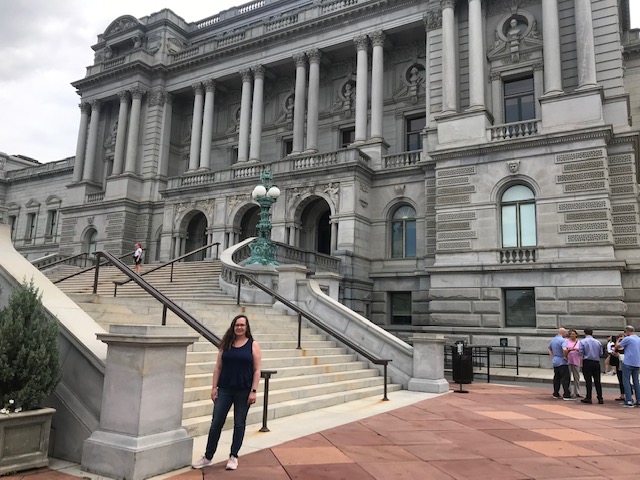 On our last day in Washington DC, we took our pilgrimage to the Library of Congress. That was also an amazing experience and we got some behind the scenes peeks of being a librarian at the LOC. It was one of our ALA attendee perks, in addition to a nice discount at the Library of Congress gift shop. This conference did take up the first 5 days of my summer break, but I enjoy the learning and the networking that happens at these large national conferences. I’m thankful to the Library of Michigan and to Karren Reish for accepting my application for the Continuing Education (CE) stipend. Finding stipends/grants/scholarships from your state or ALA provide great opportunity for all school librarians and I encourage you to apply for a stipend for professional learning that YOU may be interested in.
Thursday, April 18, 2019
Ideal Libraries Guide for Schools in Practice
I wrote this article for Follett Community, check it out:

Monday, February 4, 2019
Front Desk by Kelly Yang book review
Everyone should read this book! Read my review here:
https://libresbooksmi.blogspot.com/2019/02/front-desk-by-kelly-yang-book-review.html

https://libresbooksmi.blogspot.com/2019/02/front-desk-by-kelly-yang-book-review.html

Wednesday, January 23, 2019
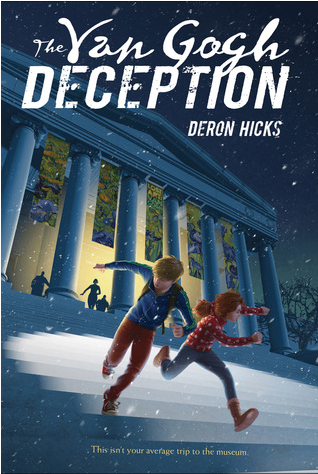
The VanGogh Deception by Deron Hicks book review
Looking for a great middle grade book?
 Try this one:
https://libresbooksmi.blogspot.com/2019/01/the-vangogh-deception-by-deron-hicks_23.html
 Try this one:
https://libresbooksmi.blogspot.com/2019/01/the-vangogh-deception-by-deron-hicks_23.html
Friday, January 11, 2019
What this story needs is a munch and a crunch by Emma J. Virján book review

So, I just discovered A Pig in a Wig books. They are super cute and a quick read. I was a little slowed down by having to read it 5 times by request. I would say that can be interpreted as a high recommendation from a 3 year old.
A Pig in a Wig elicited giggles (probably because of the rhyme) but I had to explain what a wig was. Pig was preparing for a picnic and a picnic is a 3-4 year olds favorite activity. I think some of the new vocabulary will include wig, punch, and breeze. The major attention grabber was the 2 page spread with the impending storm and the words whoosh, boom, plop, splash accompanied by looks of panic on the character’s faces. They rush to pack up their picnic, but instead of being disappointed by the rain, they just set up a picnic in the living room and continue their fun.
My little reader was especially enthralled by the bees found on several of the pages. She was concerned when they followed the characters into the living room, but then decided it was ok. The illustrations are bright and fun. There are lots of details on the pages, but they are not cluttered so I think it’s great for emerging readers. The rhymes really grab the listeners attention and it’s something that the little ones can identify with. You might need to be prepared for an immediate picnic after reading this book. I think any preK-2 grade will enjoy this book. It’s a great fit for a school library, is an engaging read aloud and I see potential for a lot of literacy based activities at different stations in the library. If you happen to be an IB PYP school, Pig illustrates what it means to be a thinker and a risk-taker.


Wandmaker by Ed Masessa book review

The story is told in the third person from multiple points of view. There was a lot of detail about what goes into wandmaking. I do think it would appeal to fans of Harry Potter, but they need to go into it knowing that this book is a different approach. Coralis becomes Henry’s mentor. He is a grouchy old man, who is a little behind the times. He does decide to come out of seclusion in order to help defeat evil. His language will make readers laugh out loud. There is humor, magic, and adventure. It does end with a lead into the next book but can stand on its own.
I would recommend this book for a school library and have it available for a free choice book. Or for a genre based assignment for fantasy picks. I think this book will go a long way in developing new vocabulary words in younger readers. There are lots of twists and enough action to entice the reader to get to the end. It will appeal to readers who love fantasy, magic, and family.
Friday, December 14, 2018
Dog Man by Dav Pilkey book review

Officer Knight and Greg the Dog are cops, who are not very good cops and always getting yelled at. They want to be heroic. Officer Knight is tough, but not very smart. Greg is smart, but his dog body holds him back. Petey wants to eliminate them because they might try to be heroic working as a team. Petey makes a bomb and Officer Knight and Greg are hurt. The only way to save them is by attaching Greg’s head to Officer Knights body. The surgery is successful and now Dog Man is the best cop ever. As the story goes on, Dog Man still gets yelled at because he does some dog-like things. But he is determined to be a hero. In the following chapters, there is some silliness, some hot dogs, lots of slobber and lots of good intentions. Evil is thwarted.
I think this book will appeal to a large range of readers. I think this book is the perfect book for kids who say they do not like to read. I think it will take readers who have been labelled "struggling" feel like they can read a book. It will engage readers from both the visual and artistic aspects because it is a graphic novel. I think it will make kids who like to doodle in school feel like what they like to do is valuable. It will connect students who get in trouble at school with the author and make them feel like they are not alone. Every school library should have the whole series in their library. They will be widely circulated between the students who say they love to read and students who say they are not readers. Having heard Dav Pilkey speak about his challenges with school and with being assigned various labels, I can see where that influences his work in this book. For example, the teacher letter getting Harold and George in trouble for not following the directions exactly. There are students who need to connect with these stories. As educators, if we truly want to give readers a choice in their reading material, we will allow students to read this book. Some of the challenging vocabulary in this book is accompanied by visuals that readers will be able to infer meaning from. This book is quite lengthy, so readers will feel accomplished by getting through a longer chapter book. This book is also just fun. There is nothing wrong with reading a book for pure enjoyment. If you don’t already have this book in your elementary or middle school library, you should get it right away! It also makes for a good gift.
Thursday, December 13, 2018
The Mesmerist by Ronald L. Smith book review

Jessamine soon finds that her power is getting stronger and she has to decide with path her future will take. Jessamine’s mother takes her to a family friend named Balthazar, where Jessamine will stay. As the adventure unfolds, readers will get to know a faerie, werewolf, Mephisto and an angel. This complex story is told in such a way that middle grade readers will be introduced and understand this tale of good and evil. The Victorian London underground will come to life through detailed descriptions and dialogue that is not too over the top for younger readers. The story is engaging and suspenseful. The cover art is attractive and will want to make you read the book right away. There are a few grisly scenes about the plague, but consistent with the time period and a some supernatural deaths. It is appropriate for a school library.
I really loved this book. There were some familiar characters like Balthazar, Mephisto and Malachai that I knew right away as an experienced reader and science fiction fan, but it may be the first introduction for younger readers. The author explored the theme of good and evil in such a way that it will not be overwhelming for the intended audience. I was impressed and how good of a job he did. I should have seen a couple of things coming, but I didn’t! It made the story that much better. There must have been a lot of research that when into this story. Get this book for your school library and push it. Your readers will thank you. Oh, and the vocabulary - when a 4th grader busts out the word “malevolent” you’ll know it is from this book.
Tuesday, November 27, 2018
The Incredible Magic of Being by Kathryn Erskine book review

Julian believes he is a uni-sensor, which means he can sense things going on in the universe. Julian believes there is magic in the universe that connects us. He is also very against burning marshmallows. When they arrive in Maine to pursue a new life, their new neighbor, Mr. X, is very crabby and slaps them with a lawsuit. He says that their house blocks his view of the lake. Julian is determined to get him to change his mind. The story unfolds with an unlikely friendship. I think this book holds a lot of appeal to middle-grade readers.
It will make readers think about their place in the universe and what family means. This book may be controversial to some because Julian and Pookie have two moms, but it is a story that needs to be told. It would be an important book for students who have 2 moms and need a feel-good story with lots of hope in it. It’s realistic fiction with just a bit of magic in it. It’s about family and friendship and I think that will bring lot of readers in. It’s a must have for a school library. I think it would be a great choice for classroom libraries, independent reading, book clubs and just for fun. There is good dialogue and different points of view to explore as a reader. Enjoyable for all ages.
Friday, October 12, 2018
Thoughts on name changing...

I think we need to re-educate parents in our schools. Starting with going back to" the library". We do have a lab in our library, makerspace activities on certain days, but it all centers around reading/research. So, we are a library.
A library encompasses all the "things". In my mind, media = tv, journalism, radio, video, photography, etc. I think inconsistency and misunderstandings tend to confuse our students, administrators, other staff and parents. "getting kids to love reading" specialist would have been better for our profession than media specialist and media center. So for all of the above reasons, I use the terms library, librarian and teacher. To me, those clearly signify what I do and where I work. I know there are a lot of opinions out there and I have spent a lot of time thinking about these things, but these are my reasons for making the professional choices that I make.
On MakerSpaces in my high school library
During a recent professional conversation on FaceBook the question was posted about the value about makerspaces and what we do with them. I am not convinced that my library is the place for it. I have long held this view and it might not be very popular. BUT, I can be pretty confident that my students will be ready for university/college life utilizing the library and going higher level research. I get that makerspaces can be tied into inquiry or project-based learning.
I would argue that we DO inquiry through research in a rigorous IB MYP and DP curriculum. My library is filled with books and access to online research databases. I am preparing them to be ready to research at the university level and teaching them to be lifelong learners by thinking through their sources of information, knowing how to find good sources and being safe online.
I DO believe that making is important and that has been the role of shop/home ec/life skills/industrial arts/engineering technology/coding classes. When schools cut those programs, they realize something is missing. It is not my job to make up for that huge curriculum gap. On the other hand, children's and teen librarianship has long provided opportunities for literacy-based crafting and "making". You make a project/craft that goes along with a book. It is fun and it comes back to reading. Librarians have always done this. I have coloring sheets, puzzles and some tabletop games available for my high school students, but I would not consider that "making." I would consider that stress relief or brain breaks or community building. I push reading, literacy, books and anything to get high school students to read. If students are not good readers, they face many challenges in life because of it. I have a degree in library science. I do not have an industrial arts degree. My library reflects my professional training and it changes and adapts and it IS a community space. But students are in here as inquirers selecting topics of interest, creating inquiry-based research questions and finding a variety of sources.
My library is filled with 100s of students every day. They are collaborating on projects, writing speeches, working on their Personal Project, researching for their Extended Essay and so many other things. We are a GAFE school - I've got a variety of Google Sites, lots of Google Classrooms, 1000s of collaborative GoogleDocs, sheets and presentations. We subscribe to NoodleTools for citation help. Follett Collections has transformed my curation of resources for staff and students. My social media library accounts on Twitter, FaceBook and Instagram see a lot of traffic. Marketing books, literacy and library services is important to me.
I see some schools who have a separate space for MakerSpaces and it is run by a STEM teacher. I can see that. I can see stations in an elementary setting (with a literary twist) and I understand that librarians work in many different types of communities. However, I am not sold on changing the mission of my high school library.
I would argue that we DO inquiry through research in a rigorous IB MYP and DP curriculum. My library is filled with books and access to online research databases. I am preparing them to be ready to research at the university level and teaching them to be lifelong learners by thinking through their sources of information, knowing how to find good sources and being safe online.
I DO believe that making is important and that has been the role of shop/home ec/life skills/industrial arts/engineering technology/coding classes. When schools cut those programs, they realize something is missing. It is not my job to make up for that huge curriculum gap. On the other hand, children's and teen librarianship has long provided opportunities for literacy-based crafting and "making". You make a project/craft that goes along with a book. It is fun and it comes back to reading. Librarians have always done this. I have coloring sheets, puzzles and some tabletop games available for my high school students, but I would not consider that "making." I would consider that stress relief or brain breaks or community building. I push reading, literacy, books and anything to get high school students to read. If students are not good readers, they face many challenges in life because of it. I have a degree in library science. I do not have an industrial arts degree. My library reflects my professional training and it changes and adapts and it IS a community space. But students are in here as inquirers selecting topics of interest, creating inquiry-based research questions and finding a variety of sources.
My library is filled with 100s of students every day. They are collaborating on projects, writing speeches, working on their Personal Project, researching for their Extended Essay and so many other things. We are a GAFE school - I've got a variety of Google Sites, lots of Google Classrooms, 1000s of collaborative GoogleDocs, sheets and presentations. We subscribe to NoodleTools for citation help. Follett Collections has transformed my curation of resources for staff and students. My social media library accounts on Twitter, FaceBook and Instagram see a lot of traffic. Marketing books, literacy and library services is important to me.
I see some schools who have a separate space for MakerSpaces and it is run by a STEM teacher. I can see that. I can see stations in an elementary setting (with a literary twist) and I understand that librarians work in many different types of communities. However, I am not sold on changing the mission of my high school library.
Monday, May 21, 2018
NewsPrints student book review by Rua

I am a sucker for graphics novels, and love how unique each art style is to the book. The art style always brings life to the characters and make the story more alive, allowing for the readers to connect with the characters on a deeper level. This book has a cartoon-y with a hint of a realistic style to it, creating a book that is open for all ages to read. It gives off a welcoming vibe, family friendly but with an edge of realistic themes that are not always happy. This is what first enticed me to read it, since it was a fictional book with a realistic edge to it, centering around a kid main character.
Graphic novels also bring in an element that novels don’t have: facial expressions. Actions speak louder than words, and having a panel on a character’s face and what emotions are being displayed can give so much more to the story than just writing “he looked almost… sad”. It gives the readers an insight into what might have made the character sad and what he will do. It allows for more dramatic irony because the readers can see more of the whole picture on all sides of the story, than just having the main characters’ points of view and no insight into the side characters. This book used dramatic irony heavily, hinting on the fact that there are many characters in the book that don’t seem to be who they say they are, hooking me to continue reading in order to find out the truth. Also, since this book’s plot was based on a mystery, facial expressions were really important because it allowed the reader to understand the mystery without anything being said, but rather what the artist shows them in each panel and how the artist focuses on specific things in each panel to clue the reader in. This only made it more interesting to read because I had a guess that the boy was a robot from the beginning, and as the story moved along more and more pieces fit the puzzle, as well as some things that tried to throw the readers off, making me want to know the truth even more and continue reading.
The art style also signals the setting of the world, where this one hints to a less modern futuristic feel and more of a older steampunk feel. As far as plot goes, this story is very unique, mostly being based on mystery and friendship, and something I loved to read. I couldn’t put it down, instead reading it all in one sitting and groaning since I didn’t have the second book yet. I believe this book is suited for younger students, elementary to middle school, because the art style is colorful and inviting, but the themes teach the children to not judge a person by one look, but rather take the time to get to know them and labels shouldn’t be what determines one’s future.
Wednesday, May 2, 2018
This Savage Song by Victoria Schwab - book review by Nicole

“Corsai, Corsai, tooth and claw,
Shadow and bone will eat you raw.
Malchai, Malchai, sharp and sly,
Smile and bite and drink you dry.
Sunai, Sunai, eyes like coal,
Sing you a song and steal your soul.” (Schwab 23)
After the monsters caused the division of V-City, the people of the North and South are expecting the truce to break. The North is ruled by Harker, a money centered man who gives protection from the monsters but only at a cost. In the South, Flynn commands the FTF and protects all within his sector. In short, the people from the North pay for their safety while the people from the South are expected to fight. In the North, Harker uses his personal control over the Malchai and Corsai in order to protect the citizens but that control is fleeting. Flynn’s control rests in his “Family”, himself and his wife running the FTF with the only three Sunai monsters in existence: Isla, Leo, and August. Even with the protection given from both sides, nowhere is truly safe.
August, the youngest monster of the Sunai, only wants to be human. Prevented from experiencing taste, pain, and his own music, August feels trapped in the demands of what it means to be a Sunai who steals the souls of sinners. As the truce starts to deteriorate, he has his chance to be human, or at least pretend to be, by infiltrating the Northern Colton Academy and getting close to Kate Harker, the only daughter of the leader of the North. Kate Harker is a human who wants to become monstrous. Stuck in private boarding schools for the past years of her life, Kate is finally brought back to V-city as her actions resulted in too much damage. Stuck in the Colton Academy, she meets August, or Freddie as his cover name, and immediately recognises that something is wrong. After only a few days they become closer but Kate only wants to deliver him to her father to prove her ruthlessness. One day after school, monsters who were thought to be controlled by Harker come to Colton Academy in order to attack the students and blame it on the Southern’s Sunai. Caught up in the fighting, Kate and August are forced to reveal their true intentions and work together to survive. In search for safety, they escape from V-city into the surrounding waste. Once they think that they had found sanctuary in Kate’s childhood home, Kate and August are discovered by Sloan, the pet monster of Harker.
In the climax, of the novel, August is forced to go dark, or reveal his monstrous Sunai form, against his will and defeats the surrounding monsters saving Kate. When Kate and August return to V-city and its chaos, they go straight to Harker’s penthouse. Finally facing her father with a changed perspective thanks to August, she is given the choice to kill him but reluctantly lets August reap his soul instead. With the death of Harker, no one in the North is safe; August forces Kate to flee and never return in order to ensure her safety. Once August returns to the South, he is determined to become the protector that they need, willing to throw away his dream of becoming more human.
As a #1 New York Times Bestseller, an Amazon Best Book of the Year, and holds a 4.17 star rating on GoodReads, I’d have to say that I love this book as much as many other people throughout the reading community. Honestly, I could not put this book down. The plotline was amazing and not predictable like many dystopian sci-fi novels that I have read and the concepts explored had so many levels to think about. I honestly cannot express how good this book was in words. Even with my lengthy plot summary, I have covered so much yet so little information throughout this book.
For an educator there are a few things to be aware of. As this book surrounds monsters and power, souls and death are common themes thought. Especially around the Corsai and Malchai, gorey murders are spread throughout the novel. Furthermore, underage smoking and other irresponsible acts such as setting a Church on fire take place as Kate actively tries to be cruel. Other than the themes of death and irresponsibility, the book is relatively clean. This book can easily be analyzed in a scholarly setting. The character development of Kate and August is the most obvious and easiest literary analysis that one could attempt but there is so much more. The role of minority characters and their development is another function used by Schwab to drive the plot. One could complete a climax analysis; there are multiple places that could be considered the climax throughout this book.
Finally, for a book club or class discussion one could consider the following questions/themes:
- What does it mean to be a Human? Monster?
- How does our past influence our current state and others?
- Analyze the impact of choices (any throughout the novel)
- Stereotypes and how they impact others/the self
- To what extent does the situation you are born into impact your destiny?
- Is destiny fixed?
- How does music impact life?
- How does one’s relationship with their family influence their beliefs?
Again, these are only a few of the many ideas explored throughout This Savage Song by Victoria Schwab and one could easily find more.
Monday, April 30, 2018
Swing it, Sunny by Jennifer and Matthew Holm book review

I think this is a good middle school graphic novel that will help readers deal with possible family issues, missing older siblings and dealing with substance abuse. It is a positive story because it shows coping skills. Kids have to learn that others might make choices that will impact their lives, but you have to try to go on living your own life. The illustrations really convey a lot of emotions and complement the text in the story. The colors are vibrant and convey a positive feeling. Hopefully most readers will be left with a positive feeling at the end of the story. This would be a good purchase for a school library. It could be used by counselors if they have students in similar situations. It could be used in literature circles or for book club. It is possible to read it as a stand alone book, but readers will have more character development understanding if they read the first story. I think that when you read it, you absorb some 1970s culture without even realizing it. I definitely recommend this book to readers from middle grade to adult.
Monday, April 16, 2018
A Few Red Drops by Claire Hartfield book review
 This is a very readable YA non-fiction history book documenting and explaining what happened during the Chicago Race Riots of 1919. During the riots 38 people died and 537 were hurt. This book starts out by explaining how segregation worked in Chicago. There were a lot of unwritten rules and invisible lines. The black community was made up of those who had been living in Chicago for a while and migrants from the south, who were looking for better opportunities. At the same time, a lot of European immigrants from Lithuania, Ireland and Germany were coming to Chicago to start a better life, but they were treated about the same as the black Americans. They worked in the meatpacking industry and other industries that were popping up in Chicago. It was a competitive job market and both sides were accusing each other of stealing jobs. Union thugs and corrupt politicians/police officers did little to make life better for blacks and immigrants. Most of these people lived in one room apartments that were like an oven during the summer months. Everyone went to Lake Michigan to cool off.
I think this is a timely purchase for a middle and high school library. It’s a good introduction to the racial divisions in this country. Students can make connections of how this event compares to more current events. Since we are in Michigan, students study the Detroit riots. This might be a good book to compare and contrast events. It would be good for a study of housing segregation and/or red-lining in cities. I think this topic could make for a good History Extended Essay topic. It think it’s important for students to notice that the author is a native of Chicago and wrote this book because she had a personal connection to it. I would recommend this to a student who read The Jungle and wants to read about more the history of the time period. Overall, I highly recommend it.
Author Website: http://clairehartfield.com/
Restart by Gordon Korman - student book review by Arav

Where do I even begin with this book? The many interesting characters? The interesting premise? The somewhat satisfying conclusion? I honestly do not know. If I had to be brief, Restart by Gordon Korman is a book that I could wholeheartedly recommend to a lot of people as, barring some slight problems, manages to deliver an interesting ride unlike any other.
The plot of Restart revolves around the character of Chase Ambrose who, due to a fall from the roof of his house, gets amnesia and has to figure out just who he was, and who he wants to be in life. Without going into too much detail, as I fear giving anything away could lessen the book’s impact, what sets Restart apart from other books are a few important details. The first of these “details” is one of the main structural draws of the book - its changing characters. While there are a few instances where the same character has multiple chapters in a row, Korman manages to shift perspective on the plot many, many times throughout the events of the plot. These shifts manage to make the book play out really well for a few reasons. For one, the shifts do not accompany a retelling of previous events from the other character’s point of view. While many other books try to retell the information to demonstrate some of the differences in each character’s personality and in their reliability, Korman simply takes that out to give the plot more focus than before. This break from convention makes the reader read critically and examine both the motivations and the reliability of each character, like how Chase learns to do through the course of the book.
Secondly, they help complicate some of the relationships between Chase and his past. For example, early in the book readers are sure to hate Bear and Aaron, Chase’s old jock friends. However, Korman then surprises us by shifting events to their perspective, forcing us to re-evaluate how we feel about them in the same manner that Chase does. While such chapters do not serve to make their actions seem logical or even reasonable, they do serve to ensure that readers do not make categorizations like “antagonist” without looking at events from their point of view. The shifts, in effect, serve to prompt readers to look at Chase’s story with both renewed suspicion and renewed sympathy, for no set of events are ever as simple as we make them to be. Besides the changing characters, Korman also excelled with the overall pacing of the story. While some amnesia storylines tend to become oversaturated with memories as the amnesiac struggles to figure out what is real and what is false, Korman pushes most of that aside to demonstrate how being a new person does not require much more than a critical look at one’s life.
Due to the many character shifts, Korman manages to selectively reveal key plot elements in a manner that honestly blew me away. While most readers will pick up on most of the subtleties, like some of the burgeoning relationships between protagonists, the overall significance of these to the plot of the book is only revealed much, much later, forcing the reader to understand some of the complexities in human communication and contemplate how hard it is to understand someone else. Additionally, due to certain surprise events, Korman manages to surprise and delight readers by completely exploring the possibilities that revolve around Chase’s situation. From making new friends to losing old ones to even learning new skills, Korman demonstrates some of the promise that life can give us, and some of the problems with trying to completely escape our past. Overall, this book is truly a delight to read, and I would wholeheartedly recommend it to anyone struggling to understand who they are in life and where life is taking them.
While the book does not end up banishing any of these problems, it helps readers understand some of the complexities of the manner and shows them that such problems do not need to impede someone from living his or her life. In terms of school usage, it would be a great way to introduce the concept of an “unreliable narrator” and a good way to talk about problems people might have socializing or trying to make friends, especially when people are trying to understand their place in society and their role in a community. In terms of extended study, it also might make for a fun way to compare the realism in literature to that of science for while Korman does make a concerted effort to stay truthful to cognitive science, his focus is on crafting a good story, one which might have some flaws scientifically. Besides these uses, however, it simply is a fun read, one which readers will enjoy for its accuracy to how they feel when entering a new school or job, whether that new locale be something as small as a middle school or as big as a college. While the last chapter could easily have been cut out, as Brendan’s summary of the story simply felt tacked on to the rest of the book, Korman manages to hit a home run on showing all of us that we can be better people, and inspires us to try to improve our lives, one step at a time.
Author Website: http://gordonkorman.com/
Subscribe to:
Posts (Atom)